How do we prove it?
An employment contract today. The full document lifecycle tomorrow. The same system.
What happens if there's a dispute later?
The system's goal is not just to produce the document — but to make it retrievable later exactly what happened.
Who accepted the document?
The system clearly shows which party confirmed the acceptance.
When did acceptance happen?
The timestamp is logged and retrievable at any time.
Which email address received the code?
The code delivery target is visible — no need to search through emails.
Which document version was in effect?
Acceptance is tied to the specific version, not just the filename.
Was a receipt generated?
The acceptance receipt is retrievable and verifiable separately.
Has the document changed since then?
If a modification occurred later, it is visibly traceable in the audit trail.
What status is the process in?
At a glance: awaiting acceptance, closed, or requires further review.
During an internal or external review, all this data is available in one place, in a readable format.
Acceptance that stays traceable.
The steps of the employee and the employer are logged separately — so it's always visible later who accepted which document version and when.
Two-sided OTP acceptance
Both the employee and the employer can confirm acceptance with their own unique one-time code. The system automatically tracks where each party is in the process.
Acceptance receipt
An archived PDF receipt is generated for each acceptance — retrievable and verifiable at any time.
Traceable event log
The system logs the time, parties, status and the linked document version. No need to search through emails and filenames during a later review.
Technical integrity
A connected event chain in the background protects the integrity of the log — it works on the IT layer; HR doesn't need to deal with it.
The detailed technical solution can be found in the 'Technical background' section.
The states of a document
The system knows exactly where every document stands. What the user sees is a business state, not a technical status — and only the system moves a document between states; it can't be overwritten by hand.
The main path
-
Draft
HR is working on it. The employee can't see it yet.
-
Awaiting signature
Issued. The employee can open it, accept it or reject it.
-
Partly signed
One side has accepted, the other is pending. The two steps are logged separately.
-
Done
Both sides have accepted. Receipt, timestamp, verification code.
Side branches
- RejectedThe employee did not accept — with a reason.
- WithdrawnHR recalled it after issuing.
- ExpiredThe deadline passed without acceptance.
All three states stay in the record. Nothing disappears, nothing is overwritten.
The stronger level
If the document type requires a qualified signature, the document is not “done” after OTP acceptance but “basic done” — shown in its own colour until the QES arrives. A state that cannot be confused with final.
Some documents only need to be issued, not signed. The system treats that as a state of its own — “issued”, not “pending” — so it never shows up as an overdue task.
Once a document has reached an accepted state, it cannot be deleted. It can be withdrawn, and archived after withdrawal — but its trace remains. That is not a setting; it is a rule of the system.
Every document has a passport
The system assigns a unique identifier to every document and embeds two QR codes — whether the PDF was generated, admin-uploaded or QES-signed. One identifies the content; the other reveals the full document lifecycle — retrievable at any time, from anywhere.
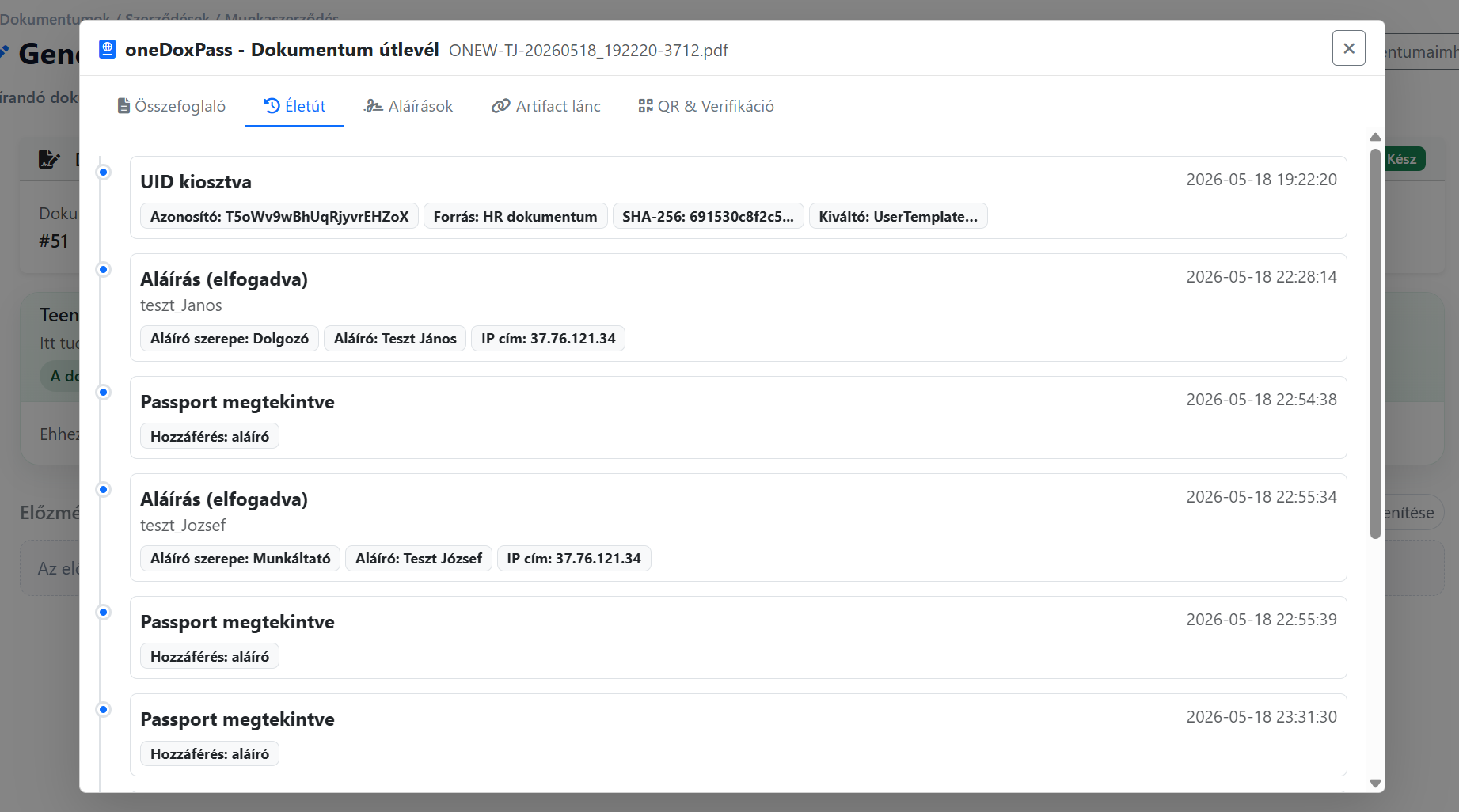
Unique document UID
Each document receives a nanoid-based unique identifier at generation time. This ID stays linked to every step of the lifecycle — from creation to archiving.
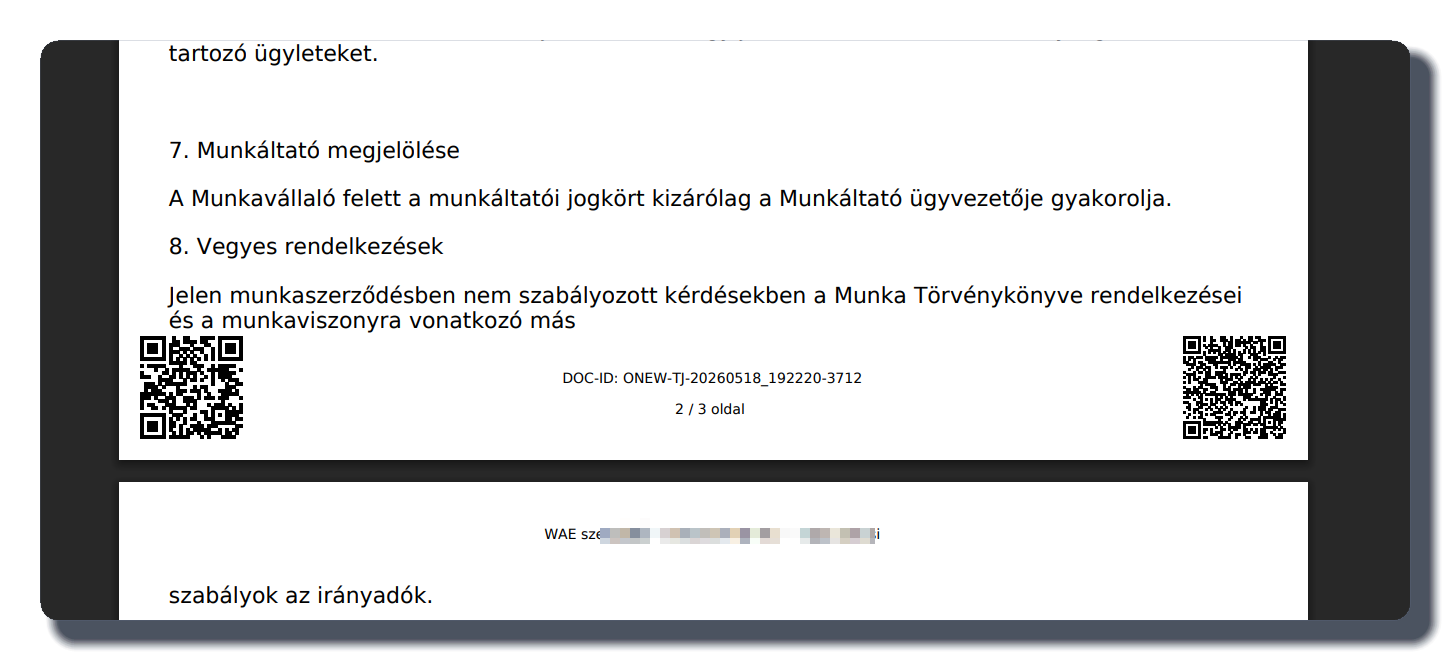
Dual QR on every page
Left QR: the Passport URL where the lifecycle is viewable. Right QR: content-hash-based verification. Both appear on every single page — retrievable even when printed.
Public verification — no login required
The Passport URL is publicly accessible: it shows the document's status and basic details. The full lifecycle is available with authenticated access (owner / admin).
Full lifecycle across tabs
Summary, Lifecycle, Signatures, Artifact chain and QR & Verification — each layer in its own tab. Admins additionally see the raw DSS payload.
Signatures tab — independent EU DSS
Each signature on its own card: signer from the certificate, Trust Service Provider (TSP), DSS INDICATION (TOTAL_PASSED), qualification level (QESIG / QES / AdES), revocation status and the full DSS report — one click away.
One QR. One proof. Anywhere, anytime.
Every issued document carries its own verification code. Anyone who scans it sees: real, untouched, and we know who accepted it — no login required.
- Type
- Employment contract
- Issued
- 2026-03-14
- SHA-256
- a1b3…f9c2
- Page
- 3 / 7
- Status
- valid · untouched
A nyomtatott vagy továbbküldött oldal is visszavezethető az eredeti rekordhoz, így a HR csapat később sem marad bizonyíték nélkül.
Page-level verification
Not just the file — a specific page is identifiable, even printed, photographed or forwarded.
Public = hash + status only
The public QR carries no PII: only type, SHA-256, issue date and status are visible. The full Passport (signers, lifecycle) requires authenticated access.
Receipt linkage
The QR points to the acceptance evidence, not just the file — you see who accepted, and when.
Independent verification
No need to log into oneDox to confirm a document's authenticity.
Paperless operation — with paper-grade verifiability.
A signature you can prove
You don't just sign something. You can also prove later who accepted what, when and under which conditions.
DAP (employee: download → external signing → upload) or connector (employer: SMS transaction code + signing PIN) — same flow, same evidence.
provider-agnosticIndependent EU DSS round for every signature: qualification level (QESIG / QES / AdES), Trust Service Provider, certificate chain and revocation status — eIDAS-traceable.
EU DSS validationTimestamp, device data, IP, acceptance context — sealed in an integrity-protected package.
evidence chainYears later, via link or QR — anyone with access can verify it for themselves.
long-term verifiableDAP, eIDAS QES or internal OTP acceptance — same flow, same evidence. The signing level is set per signer: on the same document the employee can use OTP and the employer can use QES. Employee-authenticated documents are validated via mandatory EU DSS verification before they're accepted.
QES web upload
A PDF signed by your QES provider can be uploaded, traceably logged and accepted after validation.
Employer-side integrated QES (live)
SMS transaction code + signing PIN → the connector signs the PDF → mandatory EU DSS round → save. Employer-side signing only starts after the employee-side EU DSS validation succeeds.
A signature is only worth something if it can be proven later. That's what we do.
How every step is recorded.
A simple, clear process that links the document, the acceptance and the review.
In the background, events are linked in a hash chain — subsequent modifications leave a visible trace.
Ready for review and export
Audit-ready reports help you quickly see which documents are signed, awaiting acceptance, expired or need review.
- filter by status
- search by employee
- date filter
- CSV export
- search by event ID
Audit report — sample
Audit-ready reports help you quickly see which documents are signed, awaiting acceptance, expired or need review.
Look — don't read.
Real oneDox screens from the signing inbox to EU DSS validation — always with the same question: where is this document right now?
Acceptance and signing
How does the employee accept or sign — without a paper loop?
Qualified signature — QES / DAP
When acceptance isn't enough and an authentic signature is required.
Evidence and trail
Where is this document right now — and what has happened to it?
Validation and audit
Can you prove, even later, that the signature is real?
Real system screens · personal data redacted

Technical background
This layer is for IT and review teams — on the HR side, only the key message is visible.
How does the system protect the integrity of the event log?
Events are arranged in a hash chain, so if an earlier entry were modified, the discrepancy is immediately visible. In the background, HMAC-SHA256 protects the chain; APP_SECRET is the system's own key, not user data.
What does the acceptance receipt contain?
The receipt summarises the version of the accepted document, the parties involved, the timestamp and the status. It is archived as a retrievable PDF.
What is the difference between native acceptance and QES?
Native acceptance is designed for internal HR processes; QES enables eIDAS-compatible signatures that are also valid for external processes. The two solutions serve different purposes, which is why they appear as separate use cases on the page.
How can a printed page be verified?
The QR code carries the document name, the company, the employee, the document ID, the generation timestamp and the page number. After a single scan, the original record is retrievable.
Frequently asked questions
What people ask most often before introducing it.
What is the difference between online acceptance and a qualified electronic signature?
What does the employee see?
What happens if someone prints the document?
Where does the employee find their own documents later?
What does it take to get started?
How long is a document kept?
Choose what suits you
Supports both cloud (SaaS) and on-site (on-site) deployment. Detailed service models are presented on the oneSolution page.
View details →HR School is One Solution's strategic partner: offering practical HR support, training, and interim solutions to ensure that system implementation and operations succeed not just technologically, but professionally as well.
Contact
Email address
info@onelearning.infoPostal address
One Learning Zrt.
1021 Budapest, Budakeszi 51/D C.ép. II/5